
Foundations · reviewed · reviewed Sep 1, 2026 · 3 min
What is a perceptron?
A perceptron multiplies input features by learned weights, adds a bias, and applies a threshold to choose between two classes. Its update rule can find a separating boundary when one exists, but one perceptron cannot represent a problem that is not linearly separable.
The perceptron is a learned linear threshold: useful for seeing both the basic unit of a network and the limit of one straight boundary.
One weighted decision
Suppose an input is represented by features x₁, x₂, …, xₙ. A
perceptron gives each feature a weight, adds a bias, and calculates a score:
score = w₁x₁ + w₂x₂ + … + wₙxₙ + b
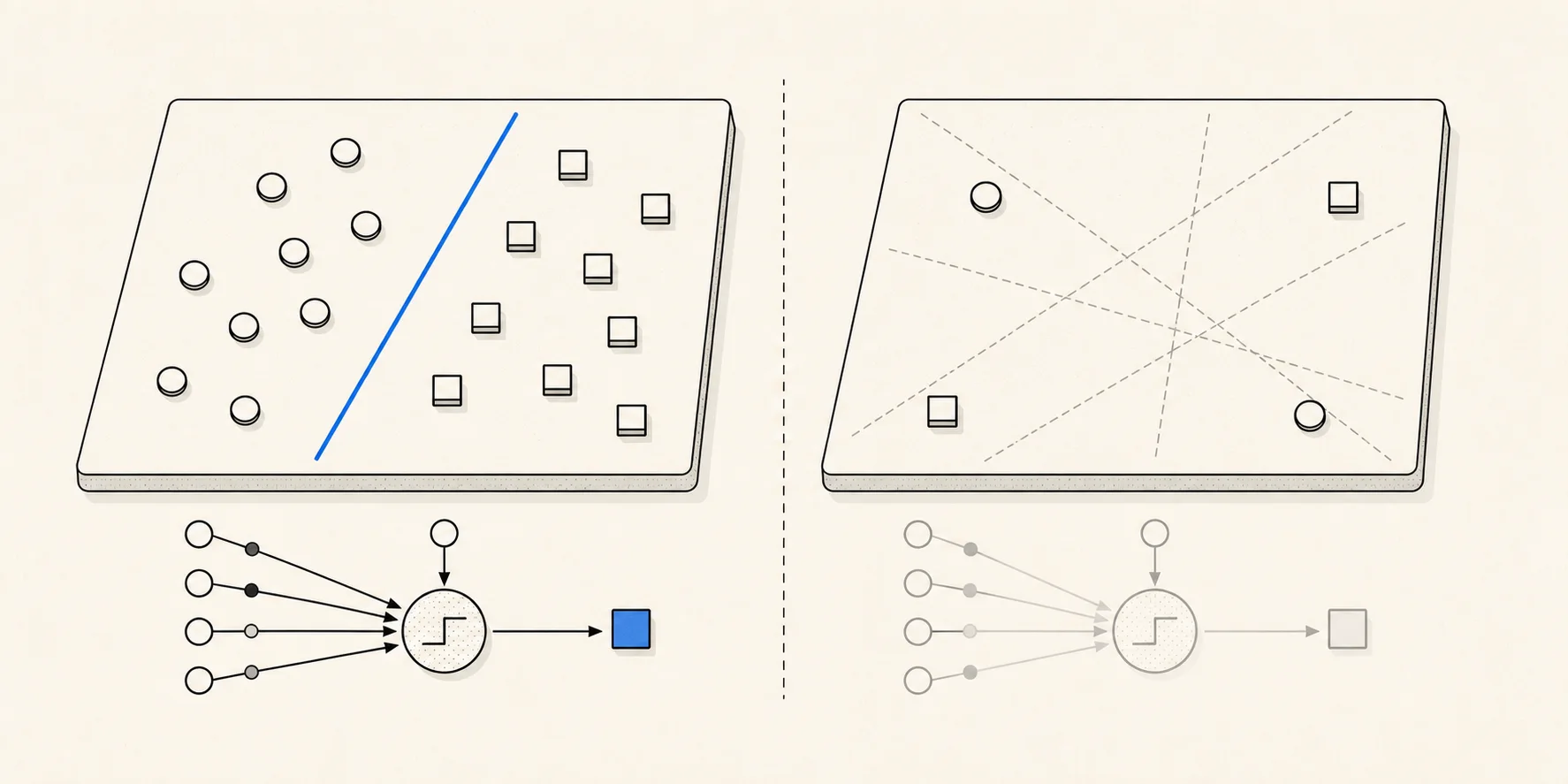
The same linear-threshold mechanism explains both panels: it can learn the blue separator when one straight boundary exists, but no single straight line separates opposite-corner XOR classes.
The sign of that score selects one of two classes. A positive weight makes its feature push the decision toward one class; a negative weight pushes toward the other. The bias moves the threshold without changing the feature values.
Geometrically, the weights and bias define a line in two dimensions, a plane in three, or a hyperplane in more dimensions. The output says which side contains the input. Calling the perceptron a “neuron” is a mathematical and historical analogy, not a claim that it reproduces a biological neuron.
Learning by correcting mistakes
Training presents labelled examples one at a time. If the perceptron predicts an example correctly, its weights can remain unchanged. If it predicts the wrong class, the update shifts the weights toward the correct label. Repeated mistakes therefore rotate and move the boundary.
For linearly separable training data, the classic convergence result says this procedure will eventually find a separating boundary under its assumptions. It does not promise the unique or best boundary, calibrated probabilities, or good performance on unseen data. Feature scale, ordering, margin, noise, and the relationship between training and production data still matter.
The XOR limit
Some class patterns cannot be divided by one straight boundary. XOR is the compact example: opposite corners of a square share a label, so every line that separates one pair splits the other pair incorrectly. A single perceptron cannot solve it regardless of how long it is trained.
That failure is architectural, not merely an optimizer problem. Combining units in layers and inserting nonlinear activation functions lets a network build intermediate representations whose final classes can be separated. This is the bridge from one linear threshold to a multilayer neural network.
Why engineers still learn it
Modern language models are vastly larger and use different components, losses, and training systems, but the perceptron exposes enduring ideas in a small form: numeric features, parameters, a forward calculation, a decision boundary, an update driven by error, and a capacity limit imposed by architecture.
It also prevents a common misconception. A learned model is not intelligent because a unit resembles a neuron or because training found weights. What it can represent follows from the complete architecture and data; what a deployed AI system can do also depends on the software around the model.
Sources
Sources and further reading
- 01The Perceptron: A Probabilistic Model for Information Storage and Organization in the BrainFrank Rosenblatt · research · published Nov 1, 1958 · source checked Sep 1, 2026
The original perceptron paper, used for the historical mechanism and the distinction between the mathematical model and a biological claim.
- 02On Convergence Proofs for PerceptronsAlbert B. Novikoff · research · source checked Sep 1, 2026
The classic concise convergence proof, grounding the bounded claim that mistake-driven updates succeed when a linear separator exists.
- 03Deep LearningGoodfellow, Bengio, and Courville · guide · published Nov 18, 2016 · source checked Aug 30, 2026
Foundational reference for optimization, backpropagation, generalization, and deep neural networks.