
Foundations · reviewed · reviewed Aug 30, 2026 · 3 min
What is the difference between training and inference?
Training changes model parameters by measuring error and applying gradient-based updates; inference keeps those learned parameters fixed and runs a forward computation to produce predictions for new input.
The same network can participate in two very different processes: parameter learning and prediction.
Two processes, one set of parameters
During training, examples enter the model, a loss function compares predictions with a target, and backpropagation computes gradients. An optimizer uses those gradients to update the parameters. Training repeats this loop over many batches and may also update auxiliary statistics used by layers such as batch normalization.
During inference, the application supplies new input and asks the trained model for output. The model performs the forward computation with fixed parameters. It does not automatically add the conversation to its training set, run backpropagation, or rewrite its weights after a correction.
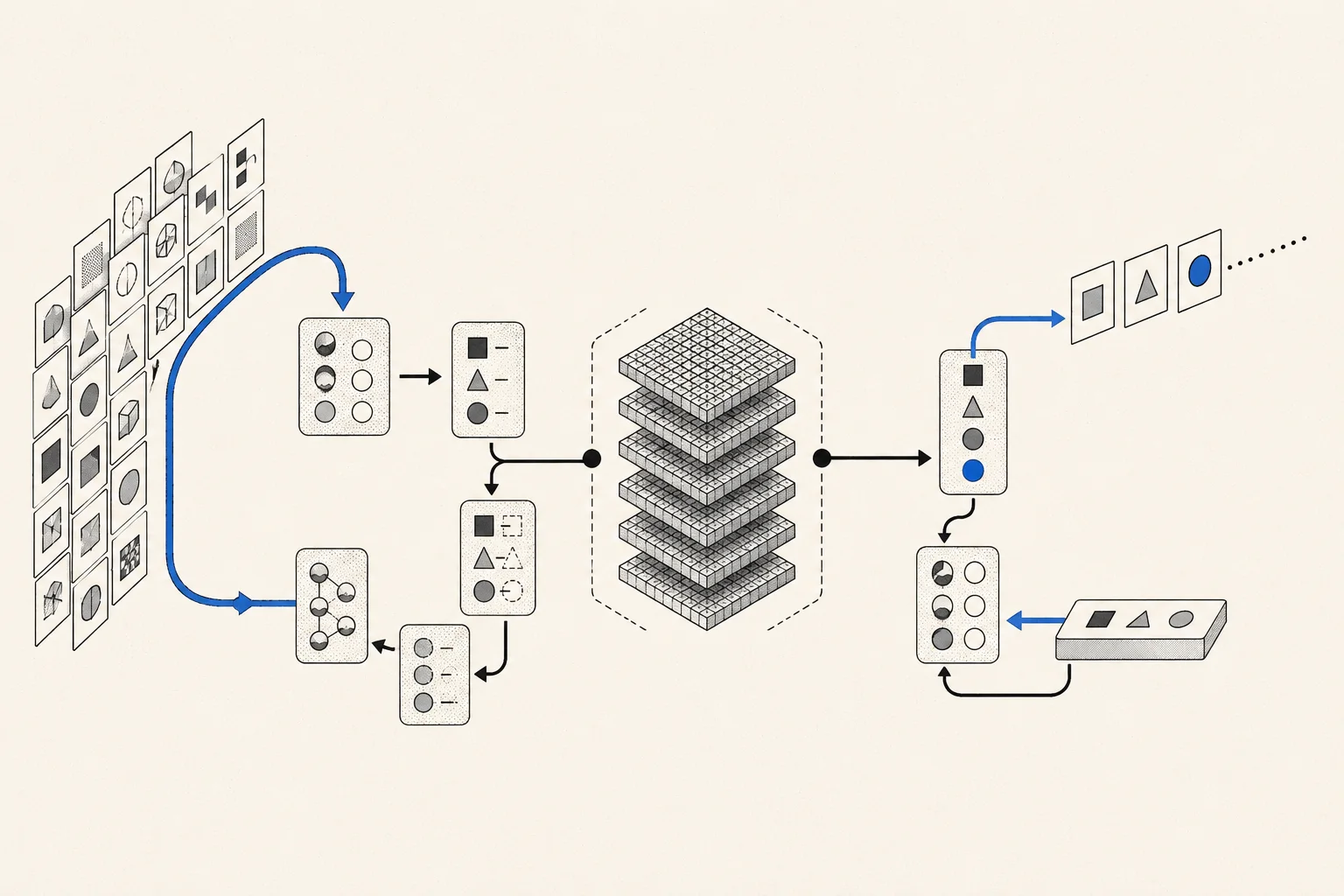
Training changes shared parameters through repeated error-driven updates; inference reuses a selected parameter artifact to process new input.
flowchart LR
  E[Training examples] --> F[Forward pass]
  F --> L[Loss against target]
  L --> B[Backward pass]
  B --> U[Parameter update]
  U --> F
  N[New input] --> I[Inference forward pass]
  P[Fixed learned parameters] --> I
  I --> O[Prediction]
The forward pass exists in both processes. The difference is what surrounds it. Training needs targets or another learning signal, gradient tracking, optimizer state, and repeated updates. Inference needs a versioned model artifact, input preprocessing, a decoding or decision rule, and operational controls for latency, cost, and safety.
Why a conversation does not usually retrain the model
An application can remember a conversation by sending previous messages again, retrieving saved notes, or writing state to a database. That is context management, not parameter training. The model may behave differently because its current input changed while its weights remain identical.
Providers may later use separately governed data to train another model version, but that is an offline data and training pipeline. It is distinct from the individual inference call. Product documentation should state retention and training policies instead of inviting users to infer them from model behaviour.
Evaluation mode is a separate switch
Some neural-network layers behave differently during training and evaluation. Dropout is normally disabled for evaluation; batch-normalization layers use stored statistics instead of updating them. Framework methods such as model.eval() select this behaviour, but they do not by themselves disable gradient recording. No-gradient or inference modes control the computation graph and related overhead.
This distinction matters in tests. A model can have fixed parameters yet still produce unexpected results if it is accidentally left in training mode. Conversely, evaluation mode does not mean that the product has been evaluated for its intended use.
Operational differences
Training often optimizes throughput over large batches and may require distributed accelerators, checkpoints, optimizer state, dataset lineage, and long-running recovery. Inference often optimizes request latency, concurrency, memory, availability, and predictable cost. Quantization, caching, batching, and specialized serving runtimes can change inference performance without changing the conceptual task.
The artifacts differ too. Reproducible training needs code, data versions, initialization, hyperparameters, random seeds, checkpoints, and evaluation history. Reproducible inference needs the exact model and tokenizer versions, preprocessing, generation settings, runtime, hardware assumptions, and request inputs.
Inference does not update learned weights
Inference is not necessarily deterministic. Sampling, floating-point kernels, parallel execution, and nondeterministic operators can produce variation while parameters stay fixed. Training is not simply “showing the model a prompt”; without a learning objective and parameter update, the prompt is context for inference.
Evaluation is also not synonymous with inference mode. Inference describes how predictions are computed. Evaluation describes the evidence used to decide whether those predictions are suitable for a declared purpose.
Verify lifecycle separation and release identity
For training, test data and label contracts, loss computation, gradient flow, optimizer updates, checkpoint recovery, reproducibility bounds, learning curves, and generalization on held-out data. Confirm that frozen parameters do not change and intended trainable parameters do.
For inference, freeze the model and tokenizer versions, select evaluation behaviour explicitly, disable gradient tracking where appropriate, and test preprocessing, output shape, decoding settings, latency, memory, batching, caching, and numerical drift across supported runtimes. Include a canary that proves two identical deterministic requests do not accidentally mutate persistent model state.
Finally, test the handoff: a checkpoint promoted from training must load into the serving runtime with the expected tokenizer, configuration, and evaluation metrics. A model that trained successfully can still be packaged or served incorrectly.
Sources
Sources and further reading
- 01Deep LearningGoodfellow, Bengio, and Courville · guide · published Nov 18, 2016 · source checked Aug 30, 2026
Foundational reference for optimization, backpropagation, generalization, and deep neural networks.
- 02Automatic differentiation with torch.autogradPyTorch · documentation · source checked Aug 30, 2026
Authoritative walkthrough of forward graphs, backward passes, gradients, and parameter optimization.
- 03Autograd mechanicsPyTorch · documentation · source checked Aug 30, 2026
Authoritative distinction between gradient recording, no-grad and inference modes, and module evaluation behaviour.
- 04Model Cards for Model ReportingMitchell et al. · research · published Jan 1, 2019 · source checked Aug 30, 2026
A primary source for intended-use documentation and disaggregated performance reporting.